
 Brij Khandelwal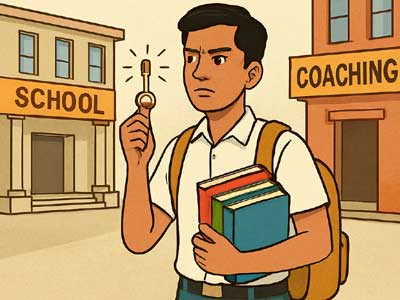
The sun isn’t even up, but Subhash is already running. Coaching tomes weigh down one hand, his frayed schoolbag the other, and the burden of an entire family’s hopes presses into his thin shoulders. The Class 12 student is locked in the brutal race for medical and engineering entrance exams—school by compulsion in the morning, coaching confinement through the day, test-series marathons at night.
Between gulps of tea and ragged breaths, he fights a quiet war to prove he is worth his parents’ life savings. Subhash is the only face in a sea of millions trapped in the same grind. Read in Hindi: स्कूलों को दरकिनार कर कोचिंग बन गई है मुकद्दर की चाभी!
Behind closed doors in the Education Ministry, a high-level committee has now said out loud what India has long refused to confront: competitive exams are no longer cleared through schools, but through coaching factories. JEE and NEET toppers overwhelmingly come from a handful of coaching giants. NCERT data shows over 90 per cent of toppers pass through these centres. Twelve years of schooling, government or private, barely matter.
In cities like Kota, Delhi, Patna, and Hyderabad, a multi-billion-rupee coaching economy has replaced the classroom. Market studies place the sector at ₹58,000 crore in 2025, projected to double within a few years. But the human cost is staggering. NCRB data shows a 65 per cent rise in student suicides over a decade; in 2023 alone, nearly 14,000 students died by suicide. Kota continues to record dozens of cases a year, burnt out by endless classes, sleepless nights and crushing pressure. Estimates suggest over 13,000 students nationwide die annually under academic stress.
Across developed nations, coaching plays only a supporting role. Strong school systems in Germany, France, Japan, Finland and South Korea enable students to reach top universities without parallel tutoring. In India, coaching has become a shadow education system, dwarfing schools and dictating futures.
Reforms under NEP 2020 have begun—flexible subject choices, hybrid learning, digital upgrades, and teacher training. But none of it matters as long as entrance exams remain detached from the school syllabus. That misalignment is the root of India’s coaching epidemic.
The government committee has now recommended three bold shifts: move JEE/NEET to Class 11, conduct them twice a year, and halve the Class 12 burden. A parliamentary panel is reviewing the coaching industry, focusing on student stress and the mushrooming of ‘dummy schools’ where enrollment exists but education doesn’t. States like Assam have already drafted regulatory laws to curb exploitative practices.
The committee wants coaching hours capped at three per day and board exams strengthened with a lighter aptitude test to produce entrance scores—an attempt to replace rote learning with real understanding. NCERT has been asked to frame a national core curriculum for Classes 11–12, and schools may soon be required to appoint qualified career counsellors to prevent students from being pushed blindly into coaching pipelines.
Progress is visible, but uneven. Curriculum collaborations are improving. Digital access is expanding. Yet coaching continues to squeeze the life out of schools—and out of children.
If India can realign exams with school learning, regulate coaching, and rebuild curriculum around real-world skills, a new balance may emerge. One where students once again earn their IIT or AIIMS seat from a school bench, not a commercial coaching bunker.
For now, coaching remains the king, schools are its subdued subjects, and childhood the silent casualty. But for the first time in years, there is a glimmer of hope: the system has begun to wake up.
Related Items
‘Real Makers of India’ don’t study in ‘Fancy Schools’
Indian startups building modern slavery!
Revive Student Unions, an instrument of democratic campus life...