
 Brij Khandelwal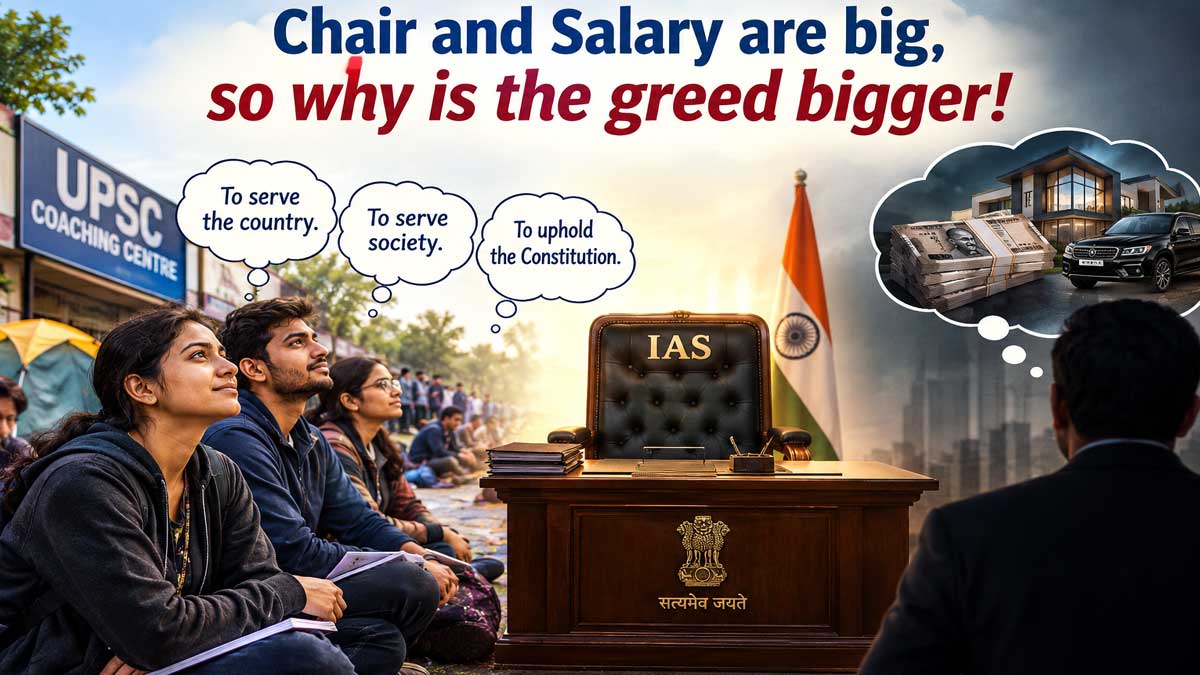
Ask the young men and women camping outside Delhi’s UPSC coaching centres what they want to become. The answer comes quickly: “An IAS officer.” And why? “To serve the country.” “To serve society.” “To uphold the Constitution.”
Wonderful. Then comes the small matter of getting the chair. Because sometimes, the moment the chair arrives, the definition of “public service” mysteriously changes. The country moves to the background. The self moves to the front.
A senior government officer is hardly left to fend for himself. There is a respectable salary. A government house. An official car. Medical benefits. Allowances. Staff. Status. Power. And, eventually, a pension. In short, the taxpayer provides the lifestyle.
The officer provides the signature. So, one question deserves to be asked: Sir, what exactly is missing? That question should haunt every senior official accused of taking bribes, manipulating contracts, misusing office or siphoning off public money.
IAS and IPS officers do not get ordinary jobs. They survive one of the country's toughest competitive examinations and enter the most powerful corridors of the Indian state.
They control files. They control permissions. They influence contracts. They implement policies. They can make things happen. They can also make things disappear into a file. This was once proudly called the “Steel Frame of India.” But steel, too, can rust. And the rust begins when power becomes enormous, and accountability becomes microscopic.
Give a person enormous discretionary power, weak scrutiny and years of delay, and temptation does not need an invitation. It walks in through the front door.
Public commentator, Prof Paras Nath Chaudhary, identifies several reasons behind corruption at senior levels: excessive discretion, lack of transparency, political-bureaucratic collusion, weak accountability, slow justice, low conviction rates and personal greed.
All true. But sometimes the explanation is much simpler. The problem is not the size of the salary. It is the size of the appetite.
For years, low salaries, inflation and financial pressures have been offered as explanations for corruption. That excuse becomes rather embarrassing when we are talking about senior bureaucrats enjoying salaries, housing, vehicles, medical facilities and a long list of official privileges.
Calling bribery a financial necessity in such circumstances is like throwing salt into the wounds of the citizen who pays the bill.
Social activist Padmini Iyer puts the irony brutally: “They enter the system carrying a bag and leave with a convoy of trucks for their private palaces.”
The line may sound sarcastic. The question behind it is not. The names change. The departments change. The governments change. The allegations keep coming.
Former coal secretary HC Gupta was convicted in several coal-allocation cases. Jharkhand IAS officer Pooja Singhal faced serious allegations linked to MGNREGA funds and money laundering. Chhattisgarh's Anil Tuteja was named in a case involving an alleged liquor syndicate.
In Haryana, cases involving Pankaj Aggarwal and Pradeep Kumar included allegations of financial irregularities, alleged diversion of bank funds and forged documents.
Rajasthan's Subodh Agarwal was named in alleged irregularities concerning Jal Jeevan Mission tendering. Uttar Pradesh's Abhishek Prakash faced allegations relating to bribery and commissions. Jharkhand's Chhavi Ranjan came under investigation in land-related cases. Some cases have resulted in convictions. Others are still before courts. And that distinction matters.
An allegation is not a conviction. A charge is not proof. A headline is not a judicial verdict. But even after making that necessary distinction, one uncomfortable question refuses to disappear: Why does the list keep getting longer? Is the government chair a platform for public service? Or, for some, has it become a VIP gateway to private wealth?
Corruption has no gender. It does not ask whether the person sitting behind the desk is a man or a woman. A male officer can abuse power. A female officer can abuse power. The law must treat both exactly the same.
The case of Pooja Singhal became one prominent example. In the NEET-UG paper-leak investigation too, women as well as men were among those whose names surfaced in connection with allegations of remembering, sharing or providing questions for money. The lesson is simple: Integrity has no gender. Neither does greed.
Then comes the familiar circus. A corruption scandal breaks. The Opposition declares: “The government has failed.” The government replies: “We have taken action.”
Television studios erupt. Press conferences multiply. Agencies investigate. Arrests make headlines. Chargesheets are filed. And then?
Silence. The case enters the courts. Years pass. Dates accumulate. Witnesses disappear from public memory. The original scandal becomes yesterday's news. An arrest becomes breaking news. A conviction becomes breaking history.
CBI and ED investigations, departmental inquiries and suspensions are necessary. But a raid is not justice. An arrest is not a conviction. A chargesheet is not the end of the story.
The final test is a judicial verdict. And when verdicts take years, the corrupt learn a dangerous lesson: The system has more patience than they have shame. The standard answer to corruption is often: Pay officials more. Give them better facilities. Improve their working conditions.
Fine. Do all of that. But do not imagine that a bigger salary automatically produces a bigger conscience.
A person determined to steal public money does not suddenly become honest because his salary rises. Greed does not retire at sixty. Government officers are custodians of public money, public authority and public trust. They are not landlords of the state.
The government office is not a private estate. The official car is not a family inheritance. The government contract is not a personal ATM. And the chair certainly does not come with a complimentary licence to become rich at the taxpayer's expense.
What is needed is not another sermon on morality. It is accountability that actually hurts. Fast trials. Serious scrutiny of unexplained wealth. Transparent decision-making. Reduced discretionary powers wherever possible. And, above all, one brutally simple principle: No chair is bigger than the law. Not IAS. Not IPS. Not a minister. Not a businessman. Not a political fixer. Not anybody. Because the chair belongs to the public.
The salary comes from the public. The privileges come from the public. And the power comes from the Constitution. The citizen gives the officer a chair. The citizen does not give him a key to the treasury. That key belongs to the people.
And the day a public servant forgets that distinction, public service becomes private service, with the taxpayer picking up the bill.
Related Items
Women build tighter workplace friendships than men
Millions of young people are educated for jobs that do not exist!
Coaching industry is both saving and destroying its children