
 Brij Khandelwal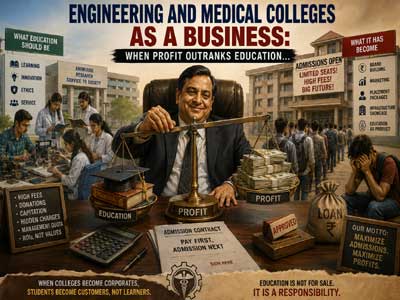
A new building stands ready. A gleaming signboard has gone up. Glossy brochures promise the future in bold type: Artificial Intelligence. Data Science. Cyber Security. Machine Learning. Robotics. ‘Admissions Open!’ The names sparkle. Enrol, the pitch suggests, and tomorrow will land neatly in your pocket.
Step inside many of these colleges and the picture changes. Rows of empty chairs stare back. That contrast captures the central irony of India’s higher professional education system today.
Read in Hindi: जब शिक्षा से ज्यादा जरूरी हो जाए मुनाफा…
Karnataka’s Higher Education Minister recently told the Legislative Council that the state has no plans to open new government engineering colleges. The reason is straightforward: 28,000 to 30,000 engineering seats remain vacant every year. What looks like retreat is, in fact, a delayed recognition of reality. Across India, 30–40 per cent of engineering seats routinely go unfilled, hundreds of thousands of empty places annually.
Tamil Nadu offers a parallel picture. After the third round of TNEA counselling in 2026, 37,943 engineering seats were still vacant even as 1,57,570 had been filled. The state has roughly 418 engineering colleges and more than 2.5 lakh approved seats. Students have not abandoned engineering. They have simply stopped accepting any college that offers a seat. Reputed urban institutions with stronger faculty, infrastructure and placement records continue to fill. Many private colleges in smaller towns and rural areas struggle; some attract almost no one.
Uttar Pradesh tells the same story in sharper numbers. After UPTAC counselling under AKTU, around 74,000 B. Tech seats remained vacant in 2026, the bulk in private institutions. Even Computer Science and Engineering, long the most sought-after branch, had more than 22,000 empty seats.
Students clustered around better-known colleges in Noida, Ghaziabad and Greater Noida. Many lesser institutions resorted to direct admissions on Class XII marks, bypassing JEE Main entirely.
The pattern is clear. Expanding capacity does not automatically create demand. Over three decades, professional colleges- engineering, medical, dental, pharmacy, management, homoeopathy- proliferated in cities, towns and even small settlements. Education gradually became a business. A seat became a product. The student became a customer.
Private colleges have refined a simple marketing formula: take a conventional Computer Science programme, attach a fashionable label, and launch a ‘new’ course. AI and Machine Learning. AI and Data Science. Cyber Security. Internet of Things. Data Analytics. The titles differ; large parts of the syllabus often do not. The brochure is new, the seat matrix expands, and the fees rise. Building laboratories, recruiting qualified faculty and supporting serious research are expensive. Redesigning a brochure is cheap. Profit prefers the easier path.
Meanwhile, seats in Mechanical, Civil and Electrical Engineering stay empty. This is a striking contradiction. India speaks constantly of manufacturing, industrial corridors, power generation, semiconductors and green energy. Yet the system funnels young people almost exclusively toward software. The risk is real: an excess of coders and a shortage of engineers who can design machines, build bridges or run power systems and factories. That is not educational planning. It is educational speculation.
An expert committee chaired by former IIIT-Bangalore director S Sadagopan underlined the deeper failure. It estimated that only about 17 per cent of engineering graduates in Karnataka could be considered directly job-ready. Parents invest lakhs of rupees; students spend four years; the degree arrives, and the labour market still finds many of them unprepared. The committee sensibly recommended reducing Computer Science intake, checking the multiplication of near-identical programmes, and integrating AI across disciplines rather than endlessly inventing narrowly branded variants.
Privatisation was once sold as the route to quality through competition. What often followed was simpler arithmetic: if one college made money, open another; if 60 seats sold, raise the intake to 120; if Computer Science was popular, create five versions of it; if admissions lagged, increase advertising.
Political influence, trusts and commercial interests shaped much of the expansion. Governments treated every new college as a development trophy. Few paused to ask whether another institution was actually needed.
Medical education faces the same temptation and the same risk. Announcements of new medical colleges make headlines. A medical college, however, is not a building with a grand entrance. It requires experienced clinicians, competent teachers, functioning laboratories, equipment and, above all, patients. Clinical training cannot be delivered through empty wards and PowerPoint slides. Without these essentials, a medical college becomes little more than a large structure with an impressive nameplate.
Homoeopathy and several other professional streams show similar mismatches: seats go unfilled while the race to open new institutions continues. If the existing shop has no customers, opening another next door is not development. India should stop treating every new college building as automatic progress.
Strengthen the institutions that already exist. Convert under-utilised campuses into centres for skilling and reskilling. Improve laboratories. Attract capable teachers. Forge genuine industry partnerships. Keep only as many seats as the country genuinely needs. Five hundred weak engineering colleges serve the nation less well than one hundred strong ones.
Vacant seats are not merely an administrative inconvenience. They are a quiet verdict delivered by students and parents against a system that has too often prioritised volume over value. Private participation can enrich education; the problem begins when education is viewed primarily as a profit centre. A college should not exist simply because it can sell seats.
Governments must start with the country’s actual requirements; how many engineers, how many doctors, in which regions, with what skills, before land, patronage and revenue calculations take over.
A college is not a shop. A student is not a customer. And a degree is not a product that can be manufactured endlessly and sold off the shelf.
Related Items
Indian startups building modern slavery!
Breaking the ice in Indian Higher Education…
Building inclusive workplaces for women…