
 Samiksha Bharti News Service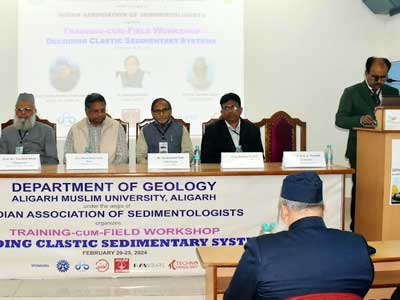
Aligarh: The Department of Geology at Aligarh Muslim University organized a Training-cum-Field Workshop on ‘Decoding Clastic Sedimentary Systems’, in association with the Indian Association of Sedimentologists.
Delivering a plenary lecture on ‘Energy Resources and Energy Security in India’ during the inaugural session, the chief guest, Dr. Kalachand Sain, a renowned geophysicist and Director at Wadia Institute of Himalayan Geology in Dehradun, said that energy is the main driver for socio-economic development of any country and the unconventional energy resources like submarine gas-hydrates, shale gas/oil, and Coal Bed Methane have great potential in India.
He said that the science-technology-innovation interface is crucial to tap these resources in an economically affordable and environmentally safe manner.
The guest of honor, Prof. Partha Pratim Chakraborty from the University of Delhi explained the nuances of sequence stratigraphy and its importance in the petroleum industry. He said that sequence stratigraphy provides a comprehensive understanding of the depositional history of sedimentary basins and plays a pivotal role in the petroleum industry, particularly in the exploration and production of hydrocarbons.
Other guests and experts who attended the workshop as resource persons included Dr. Sandip Roy, Riyasat Husain, Prof. Uma Kant Shukla, Dr. Arvind Kumar Singh, and Dr. Yunus Ali.
In his presidential remarks, Prof. QH Ansari, Dean, the Faculty of Science, said that the workshop has received an overwhelming number of participants from across the country and this is satisfying to note that the students are taking an interest in geological studies in growing numbers.
Prof. Farahim Khan, Chairman of the department, said such workshops that include fieldwork are rare and it is the need of the hour to inculcate in young students a basic understanding of the subject and provide them with hands-on training through the fieldwork.
Prof. Akram Javed discussed the subject matter and said it is an important opportunity for our students to learn the basics of fieldwork under the guidance of renowned experts in this field.
Prof. MEA Mondal, Convener, said that the workshop provided the participants with an opportunity to apply theoretical knowledge to practical scenarios, enhancing their skills and understanding in these areas.
Dr. Iftikhar Ahmad, Organizing Secretary, presented a detailed report during the valedictory function and said the workshop served as a platform for the participants to gain a comprehensive understanding of clastic sedimentary systems and sequence stratigraphy.
He said that the workshop included lectures, tutorials, hands-on exercises, drone-based tutorials, and a 2-day fieldwork in Bayana, a historical town located in the Bharatpur district of Rajasthan.
The event also featured a two-day dedicated workshop on sequence stratigraphy, a method developed to support geoscientists in the geologic interpretation of subsurface data.
More than 110 participants from different institutions from across India attended the workshop. The outstation participants included students from MS University of Baroda, Kumaun University, University of Calicut, Birbal Sahni Institute of Paleosciences, IISER Kolkata, University of Kerala, University of Lucknow, Indian Institute of Petroleum and Engineering, KJ Somaiya College of Science and Commerce, Central University of Kerala, University of Delhi, IISER Mohali and ONGC University.
Dr. Sandip K. Roy, a Retired Petroleum Geoscience Expert from Petronas of Malaysia, was the chief guest at the valedictory session.
Prof. Rashid Umar extended a vote of thanks.
Related Items
Indian startups building modern slavery!
Can 'Indian Coaching Giants' inspire without misleading?
Breaking the ice in Indian Higher Education…