
 Brij Khandelwal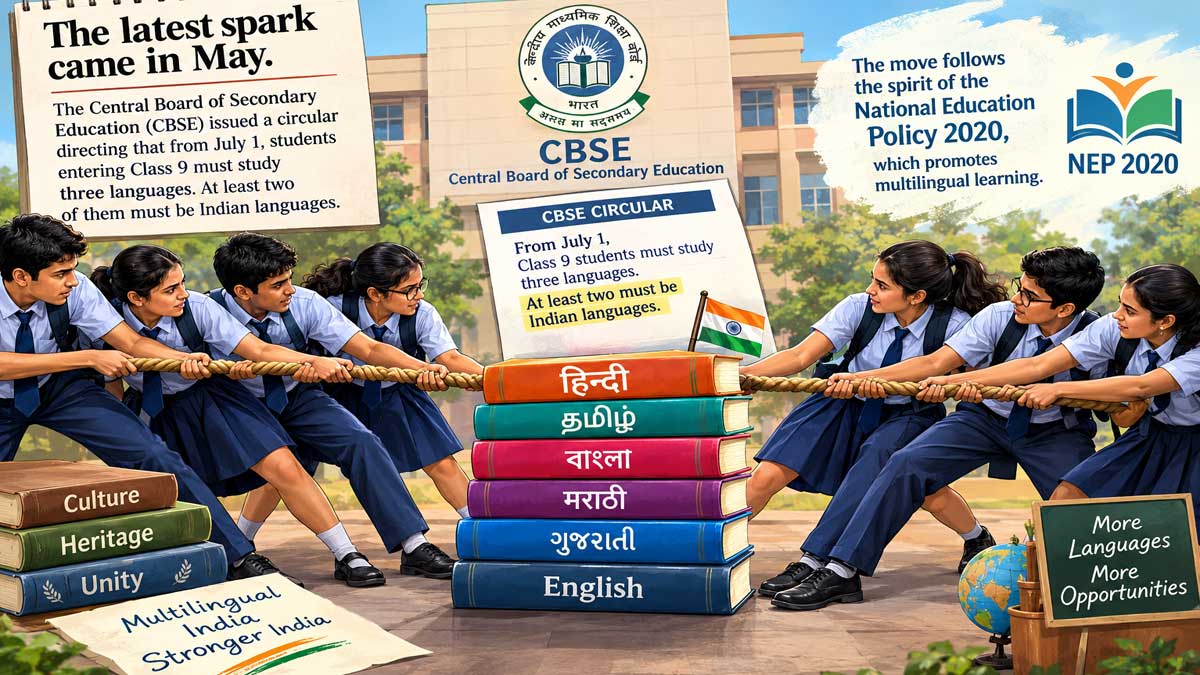
Can a school timetable trigger a political storm? In India, it certainly can. Here, language is never just about alphabets and grammar books. It is emotion. It is identity. It is memory. Sometimes, it is even a battlefield.
The latest spark came in May. The Central Board of Secondary Education issued a circular directing that from July 1, students entering Class 9 must study three languages. At least two of them must be Indian languages. The move follows the spirit of the National Education Policy 2020, which promotes multilingual learning.
On paper, the idea sounds harmless, even noble. A multilingual India producing multilingual children. What could be wrong with that?
But the circular landed like a stone in troubled waters. Parents panicked. Teachers complained. Education activists protested. Petitions quickly reached the Supreme Court. Critics argued that introducing a third language in the middle of an academic session would burden students already preparing for board exams. Rural schools, many said, do not even have enough language teachers. Some schools struggle to teach English properly. Where will they suddenly find trained Tamil, Kannada, Bengali or Hindi teachers?
The debate reopened old wounds. In India, language politics never really sleeps. It merely changes sides.
The roots of this conflict go back to the birth of the Republic itself. When the Constitution was drafted, the question haunted lawmakers: what should independent India speak? Hindi supporters wanted Hindi to replace English completely. Others feared domination by the Hindi belt. The compromise came through Article 343. Hindi in Devanagari script became the official language of the Union, while English would continue for fifteen years as an associate language. But deadlines can become ticking bombs.
As 1965 approached, panic spread in southern India, especially in Tamil Nadu, then Madras State. Many feared Hindi would eventually swallow regional languages and reduce non-Hindi speakers to second-class citizens in jobs and administration. Then came the explosion.
Students poured onto the streets. Slogans filled the air. Trains were stopped. Public property was attacked. Several people died in police firing and violence. The anti-Hindi agitations of 1965 changed Tamil Nadu forever. Congress lost its grip on the state. Dravidian parties rose like a political tsunami. They remain dominant there even today. Delhi blinked.
The Centre assured states that English would continue alongside Hindi. Tempers cooled. But suspicion remained buried like embers under ash.
Out of this turmoil emerged the famous Three-Language Formula. The Kothari Commission during the 1960s proposed it as a middle path. Later, the National Policy on Education formally adopted it. The idea was elegant. Every Indian child should learn three languages. The mother tongue or regional language would come first. Hindi or another Indian language second. English or another modern language third.
The dream was beautiful. A Tamil child could read Hindi poetry. A Hindi-speaking student could appreciate Tamil literature. A Bengali could converse with a Maharashtrian. Unity through language diversity, according to social scientist TP Srivastava. But India has a habit of making neat ideas messy. Implementation became wildly uneven.
Tamil Nadu simply refused to follow the formula. It stuck firmly to its two-language policy: Tamil and English. Meanwhile, many Hindi-speaking states quietly escaped the burden of learning southern languages. In several schools, Sanskrit became a convenient substitute. The ‘exchange of languages’ remained largely one-sided. This hypocrisy still irritates southern states.
Social activist TN Venkat explains, "A Tamil student often learns Tamil, English and Hindi. But how many students in Uttar Pradesh or Bihar seriously study Tamil, Telugu or Malayalam? The imbalance is impossible to ignore."
Politics enters classrooms through the back door. Supporters of multilingualism argue that India cannot survive emotionally if its citizens remain trapped in linguistic islands. They say language learning broadens minds. It builds empathy. A Punjabi reading Subramania Bharati or a Gujarati understanding Bengali songs creates cultural bridges stronger than political speeches.
Research also supports multilingual education. Children exposed to multiple languages often develop stronger cognitive flexibility and communication skills. Europe celebrates multilingualism proudly. Why should India fear it? Critics counter with a more practical question. Who will teach these languages?
Hari Dutt, a secondary school teacher, comments, "In thousands of Indian schools, basic infrastructure itself remains fragile. Rural schools lack teachers, laboratories and even functioning toilets. Many parents are desperately pushing children toward English-medium schools because English is seen as the passport to jobs and upward mobility."
This is India’s great linguistic irony. Public commentator Paras Nath Choudhary observes, "Politicians praise Indian languages on stage. Elite families quietly send their own children to English-speaking schools. English continues to dominate courts, corporations, higher education and aspirational life. A farmer may speak proudly in Hindi or Tamil. But when his child gets a job offer from a multinational company, English suddenly becomes priceless."
Language debates in India are rarely about language alone. Beneath them lie deeper anxieties about power and opportunity.
Retired educationist Ram Gopal says, "The current CBSE controversy reflects exactly this tension. Critics are not merely objecting to another subject in the timetable. They fear centralisation. They fear cultural dominance. They fear decisions being imposed uniformly on a country that functions through diversity, not uniformity." And India’s history offers reasons for caution.
Language has repeatedly reshaped the nation’s map. After independence, states were reorganised largely on linguistic lines. Andhra Pradesh emerged after Potti Sriramulu fasted to death demanding a Telugu-speaking state. Maharashtra and Gujarat were later formed after fierce linguistic mobilisations. Language has toppled governments, fuelled protests and redrawn boundaries.
Few forces stir emotions in India as deeply as language does. The Supreme Court will now examine whether the CBSE directive violates constitutional principles or places unfair burdens on students and schools. Judges may interpret legality. Bureaucrats may discuss logistics. Experts may cite educational research. But courts cannot settle emotional history. That battle continues in homes, classrooms and political speeches across India.
The three-language formula was conceived as a bridge. Yet decades later, it still resembles a tightrope. Every government tries to walk across it carefully. Every state watches nervously. Every parent worries silently about the child carrying the load.
India’s linguistic diversity is both its poetry and its problem. Here, language is not merely spoken. It is defended like territory.
Related Items
‘Real Makers of India’ don’t study in ‘Fancy Schools’
India’s Pedagogical Crisis and the Erosion of the Teaching Profession
Crumbling schools, Soaring dreams; Can India become ‘Vishwa Guru’?