
 Brij Khandelwal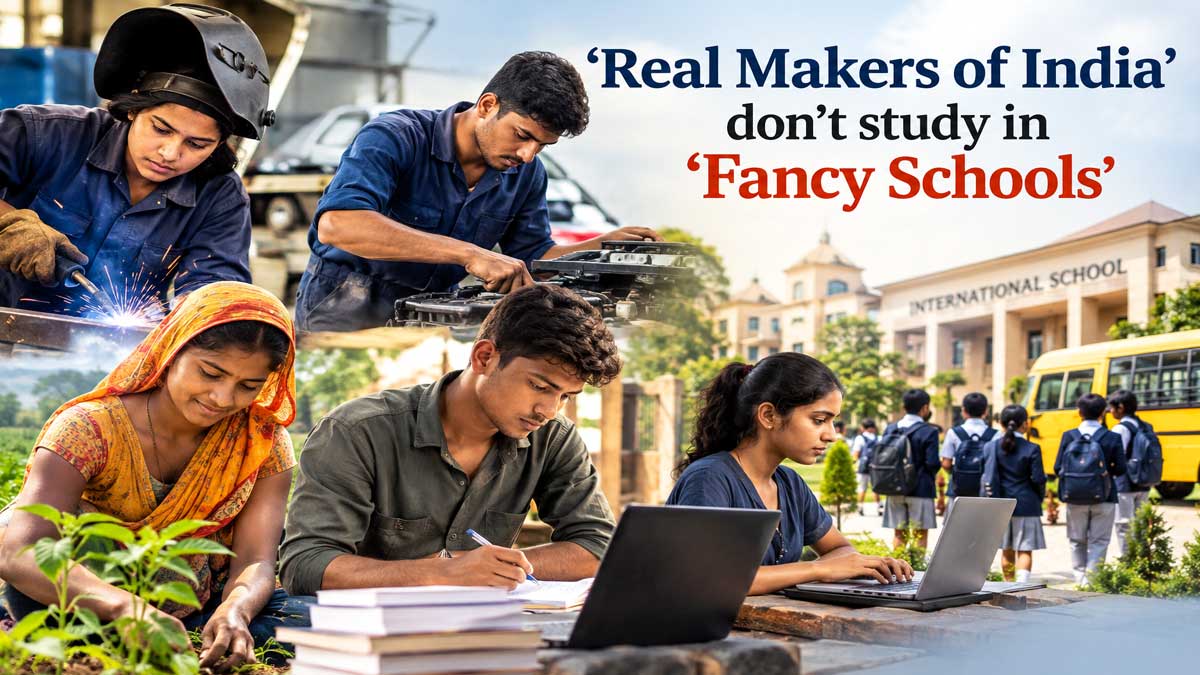
What really creates success in India? A shiny campus with imported furniture and air-conditioned classrooms? Or the hunger to rise, learn, struggle, and survive?
In today’s India, many parents believe that only elite, high-profile schools can secure a child’s future. Huge fees are paid for ‘international’ education, smart boards, designer uniforms, and polished English accents. School brochures look like luxury resort advertisements. Education has become a status symbol. But history tells a very different story.
Also read: चमचमाते ‘एलीट’ नहीं, ‘साधारण’ स्कूल हैं भारत के असली निर्माता
The real builders of modern India have mostly come not from elite boarding schools, but from ordinary government schools, Kendriya Vidyalayas, municipal schools, convents, and affordable private institutions. The people who shaped India’s democracy, economy, science, military, medicine, and administration were often students of simple classrooms with cracked walls, crowded benches, and limited facilities.
In the small town of Vadnagar, a boy named Narendra Modi studied in a modest local school. There were no smart screens or imported playgrounds. Years later, he became Prime Minister of the world’s largest democracy. The same story repeats across India.
Dr APJ Abdul Kalam, India’s “People’s President” and missile scientist, studied in an ordinary school in Tamil Nadu. Lal Bahadur Shastri came from a humble educational background in Uttar Pradesh. President Droupadi Murmu studied in government institutions in Odisha. Ram Nath Kovind too came through the mainstream education system.
These leaders were not raised inside privileged bubbles. They grew up among ordinary Indians. They saw poverty, shortages, social divisions, and daily struggles from close quarters. That experience gave them resilience and emotional understanding. It connected them to the real India.
Elite schools certainly produce capable students. Many alumni do well in business, media, and global careers. They often benefit from confidence, networking, exposure, and polished communication skills. But when we look at nation-building roles, the picture changes dramatically. The corporate world offers powerful examples.
Dhirubhai Ambani studied in a simple school in Gujarat before building one of India’s largest business empires. Narayana Murthy of Infosys attended government schools in Karnataka. Gautam Adani came from an ordinary educational background. Sunil Mittal and Shiv Nadar also did not emerge from luxurious boarding schools.
These entrepreneurs built companies through risk-taking, hard work, and street-smart adaptability. They learned to survive before they learned to lead. In many ways, scarcity became their greatest teacher.
India’s armed forces tell the same story. Captain Vikram Batra, hero of the Kargil War, studied in regular schools in Himachal Pradesh. Field Marshal KM Cariappa came from a mainstream educational background in Karnataka. Thousands of brave soldiers and officers defending India’s borders today are products of government schools, Sainik Schools, Kendriya Vidyalayas, and local institutions.
The military does not care much about family status or school glamour. It rewards courage, discipline, and performance. A bullet on the battlefield does not ask whether a soldier studied in a five-star campus.
The UPSC civil services examinations provide perhaps the strongest proof of all. Every year, IAS, IPS, and IFS toppers emerge from ordinary schools across India. Many studied in Hindi-medium institutions, Kendriya Vidyalayas, Navodaya schools, or affordable private schools. They come from villages, small towns, and middle-class families.
Their success shows something important. Competitive exams in India still reward determination more than school branding. Hard work matters more than polished accents. Discipline matters more than designer campuses.
Even in medicine and science, the pattern continues. AIIMS doctors, scientists, surgeons, and researchers often come from modest educational backgrounds. Many NEET toppers are products of government schools or ordinary coaching systems. They succeed through relentless study, not luxury infrastructure.
India’s sports heroes also prove the point. Sachin Tendulkar studied in Sharadashram Vidyamandir. MS Dhoni came from Jawahar Vidya Mandir in Ranchi. PT Usha studied in government schools in Kerala. Their talent was sharpened through effort and grit, not elite privilege.
So why does society continue worshipping expensive schools? Partly because of a colonial hangover. Indians still associate English-speaking polish and exclusivity with superiority. A school today is often treated less as an educational institution and more as a social status badge.
Parents proudly discuss fees, foreign trips, and imported teaching systems as if they are buying luxury cars. But education is not a fashion parade.
A child’s future depends far more on values, discipline, curiosity, mentorship, and perseverance than on marble floors or digital boards. In fact, ordinary schools often teach something priceless: survival.
Students there compete despite limitations. They travel in crowded buses, study during power cuts, share books, and fight social and financial odds. Such experiences build mental toughness. They create grounded individuals who understand ordinary people and real-life struggles.
This is why mainstream schools remain India’s true strength. They democratise ambition. They give millions of children a fighting chance. They create first-generation graduates, officers, scientists, and entrepreneurs. They keep the ladder of opportunity open.
India’s higher education system also acts as a great equaliser. IITs, AIIMS, NDA, and UPSC examinations allow talented students from modest schools to compete nationally. A bright student from a village school can still dream big. That is the beauty of India’s democratic system.
Of course, this does not mean mainstream schools are perfect. Many government schools suffer from poor infrastructure, teacher shortages, outdated methods, and weak accountability. These problems must be fixed urgently.
Instead of blindly copying expensive international models, India should invest seriously in strengthening ordinary schools. Better teachers, libraries, sports grounds, digital access, and practical learning can transform millions of lives.
The goal should not be to create a few elite islands of excellence surrounded by oceans of neglect. The goal should be quality education for every child. Because when a small-town school produces the next Abdul Kalam or Vikram Batra, the entire nation benefits.
Modern India was not built inside exclusive elite campuses. It was built in ordinary classrooms filled with extraordinary determination. That truth deserves far more respect than it receives today.
Related Items
India’s never-ending language tug-of-war…
India’s Pedagogical Crisis and the Erosion of the Teaching Profession
Revive Student Unions, an instrument of democratic campus life...