
 Brij Khandelwal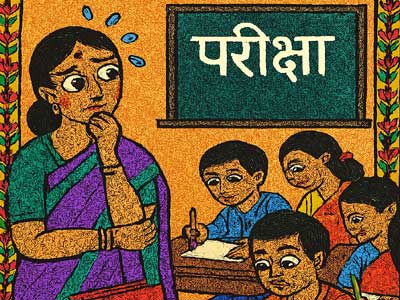
A teacher who cannot speak proper English teaches English grammar. A classroom packed with sixty children runs without a blackboard and a fan in May heat. A B.Ed. topper freezes before noisy students on the first day of school. Parents touch a guru’s feet at weddings, but bargain with school management over teachers’ salaries like vegetable prices. Welcome to the strange contradictions of India’s education system.
The nation that worships Saraswati is slowly sidelining its teachers. Degrees are multiplying. Coaching centres are booming. Schools are opening in every lane. Yet genuine learning is shrinking like water in a summer pond. Something vital has cracked inside India’s classrooms.
India once treated teachers as moral anchors and architects of society. The village ‘masterji’ carried enormous authority. Parents feared him, respected him, and trusted him. Teachers were not merely employees. They were character builders, counsellors, disciplinarians, and role models rolled into one. Today that old respect is fading like chalk marks after rain.
India is facing a serious pedagogical crisis. Weak teacher preparation, poor classroom practices, collapsing standards, declining social prestige, and mechanical learning have hollowed out the teaching profession. The damage is no longer limited to schools. It now threatens the country’s social and economic future.
At the heart of the crisis lies a dangerous illusion. India has lakhs of trained teachers carrying impressive qualifications: B.Ed., M.Ed., diplomas, certificates, workshops, seminars. Yet many lack subject mastery, classroom confidence, communication skills, or teaching imagination. Degrees have become decorative garlands. Real teaching ability often remains missing.
A degree in education does not automatically create a good teacher. Unfortunately, the system behaves as if it does.
The reality inside many schools is painfully different from official reports and glossy brochures. In several government schools, English teachers themselves struggle to speak fluent English. Pronunciation is weak. Vocabulary is limited. Reading habits are poor. Literature exposure is minimal.
Students memorise textbook paragraphs like parrots trained for examination cages. But ask them a simple real-life question, and silence fills the room.
A retired bureaucrat once recalled visiting a rural school in Uttar Pradesh. The certified English teacher there could not hold a basic conversation in English. Children had memorised entire lessons mechanically, but could not independently form even simple sentences. This is not education. It is mass-produced memorisation.
The disease is not confined to government schools alone. Many private schools wearing the shiny mask of ‘international’ or ‘smart’ education operate on fragile foundations. Teachers are often underpaid, overworked, insecure, and poorly trained. Some receive salaries lower than delivery workers or mall staff.
How can society expect dignity in teaching when teachers themselves struggle for survival?
Once upon a time, becoming a teacher was considered a noble calling. Today, many enter the profession not out of passion, but because other opportunities failed. Teaching has become the ‘last bus at night’ for countless unemployed graduates. The deeper rot, however, lies in pedagogy itself.
In Indian classrooms, curiosity is treated as a disturbance. Questioning is mistaken for indiscipline. Creativity rarely fits inside answer sheets.
Teachers lecture endlessly. Students copy endlessly. Exams reward memory rather than understanding. Marks become gods. Thinking becomes the casualty.
Children learn how to reproduce definitions, not how to analyse ideas. They pass examinations yet fail life skills. Many graduates cannot draft a proper email, hold a confident conversation, solve practical problems, or think independently.
The tragedy begins inside teacher-training institutions themselves. Many B.Ed. programmes remain trapped in outdated theories and paperwork. Trainees spend endless hours writing lesson plans and educational philosophy assignments, but receive little exposure to actual classroom realities.
A young trainee in Delhi admitted bluntly, “My B.Ed. taught me how to write files, not how to teach weak students or control a noisy class.” That one sentence captures the entire crisis.
Internships are often symbolic. Mentoring is weak. Demonstration teaching is superficial. Many new teachers enter classrooms without knowing how children actually learn. Some have never been properly trained to teach reading comprehension, encourage discussion, or handle mixed learning levels.
Even teacher educators frequently lack modern exposure. District-level training institutes in many states suffer from outdated faculty, weak digital literacy, and little understanding of contemporary teaching methods. Workshops become boring rituals where attendance matters more than learning. Then comes the brutal reality of infrastructure.
Overcrowded classrooms. Broken benches. Empty libraries. Weak internet access. Teacher shortages. Multi-grade teaching. Administrative overload. Endless paperwork.
In countless rural schools, one exhausted teacher manages several classes simultaneously. Under such conditions, personalised attention becomes impossible. Teaching turns into survival management. Social change has further complicated the situation.
In the rush to imitate Western educational trends, India has sometimes confused friendliness with the collapse of authority. The idea that teachers must only behave as ‘friends’ has diluted discipline in many classrooms. Respect has weakened. Fear vanished long ago. Accountability disappeared quietly behind it.
Many teachers privately admit that students increasingly show little regard for teachers or even parents. Mobile addiction, shrinking attention spans, and declining reading culture have worsened the challenge.
The old ‘masterji’ of the village- strict, respected, committed, and socially influential- is disappearing from public life like an endangered species. And when teachers lose authority, classrooms lose direction.
Weak education traps generations in low confidence, poor communication, and limited opportunities. Schools meant to become ladders of mobility instead become holding camps of frustration.
Teachers deserve better salaries, stronger social respect, and clear professional growth pathways. Schools need libraries, teaching aids, digital infrastructure, and smaller classrooms that encourage interaction rather than memorised silence.
Most importantly, India must stop treating education merely as a statistics game of enrollments, schemes, and certificates. Education is ultimately about human beings shaping other human beings.
Related Items
Indian startups building modern slavery!
Colleges as a Business: When profit outranks education…
Coaching industry is both saving and destroying its children