
 Brij Khandelwal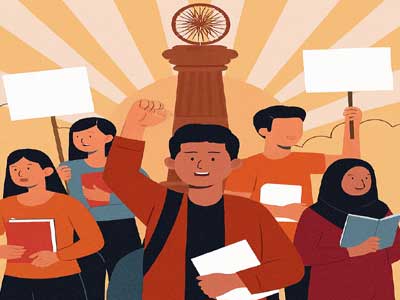
Student unions once occupied a central place in university life across India. Their utility was widely acknowledged. They offered structured avenues for participation beyond the classroom, trained young people in democratic methods, channelled energies into constructive outlets, and linked students with institutional authorities.
The Education Commission of the 1960s recommended compulsory membership precisely because properly organised unions fostered self-government, self-discipline, and leadership. In several institutions they ran cooperative canteens and stores, organised literary and cultural activities, and provided forums for grievances. These functions remain relevant; the case for reviving them is stronger today than ever.
Read in Hindi: राजनीति को चाहिए नया खून, छात्र संघों की वापसी अब जरूरी
The 1960s and 1970s witnessed intense student unrest and activism that demonstrated both the power and the risks of organised campus politics. The 1965 anti-Hindi agitation in Tamil Nadu, led largely by students, forced the central government to retain English as an associate official language and reshaped the state’s political landscape in favour of Dravidian parties. Later in the decade, Naxalite-inspired radicalism drew many students into revolutionary politics. The decisive phase came in 1974.
In Gujarat, the Navnirman movement began with protests against a hostel mess-fee hike and rapidly escalated into a statewide campaign against inflation and corruption, forcing the resignation of the chief minister and the dissolution of the assembly, the only instance in independent India of sustained student-led agitation toppling an elected state government.
Inspired by this, students in Bihar launched their own agitation, which Jayaprakash Narayan transformed into the call for ‘Total Revolution’. The movement challenged the Indira Gandhi government, contributed to the climate that produced the Emergency of 1975, and later helped forge the opposition coalition that defeated Congress in 1977. These upheavals showed that student organisations could become powerful instruments of democratic pressure, yet they also revealed how quickly campus bodies could be drawn into larger partisan contests.
In the decades that followed, successive governments responded to recurring violence, political infiltration, and disruption by suspending or curtailing student-union elections.
In Uttar Pradesh, the Charan Singh government in 1967 made membership optional; participation collapsed, and unions became largely defunct until later revival. Similar suspensions occurred elsewhere.
In later years, administrations under leaders including Kalyan Singh and others in Uttar Pradesh and other states imposed temporary or longer bans, citing law-and-order concerns, academic disruption, and the capture of unions by external political interests.
Institutions such as Banaras Hindu University (last full elections in the mid-1990s), Lucknow University, and several others effectively ended or replaced elected unions with nominated councils. The pattern was clear. When unions were allowed to become citadels of dirty partisan politics rather than vehicles of student welfare, authorities preferred suspension to reform.
Yet these failures do not justify permanent abolition. They demonstrate the consequences of neglect and poor design. The underlying purposes- developing leadership, promoting cultural and recreational life, identifying talent, facilitating community service, and providing democratic training- have not disappeared. Modern universities confront new pressures: rising student anxiety and mental-health concerns, the need for soft skills and civic competence, demands for greater transparency in administration, and the risk of polarisation without organised counter-channels. The absence of representative student bodies leaves a vacuum filled by informal groups or sporadic protests that often lack accountability.
History itself supplies the strongest argument for revival. Many leaders who later shaped national politics first learned organisation, negotiation, and public speaking through student unions or campus movements.
Arun Jaitley rose through the Delhi University Students’ Union and the ABVP during the JP movement years. Lalu Prasad Yadav and Nitish Kumar emerged from the Bihar student agitation of the mid-1970s. Sitaram Yechury and Prakash Karat cut their political teeth in the Jawaharlal Nehru University Students’ Union. Mamata Banerjee began in student politics in Kolkata.
Others such as Nitin Gadkari, Rajnath Singh, Ashok Gehlot, and Prafulla Kumar Mahanta (from the Assam movement) followed similar paths. Campus politics functioned as a nursery of democratic leadership precisely when it combined activism with institutional structure.
A revived student-union system, redesigned rather than simply restored, can recover that constructive role. Unions should prioritise extra-curricular and co-curricular work, debating, cultural festivals, sports, skill workshops, while serving as formal platforms for grievance redressal on academic, infrastructural, and welfare issues through structured dialogue.
Regular joint conferences between elected representatives and university authorities, long recommended but rarely institutionalised, would convert disputes into negotiated improvements. Teacher involvement remains indispensable: automatic membership of teachers and students in a broader university union, with faculty representation on committees, can supply guidance without stifling initiative.
Mandatory leadership training in negotiation, budgeting, ethical campaigning, and inclusive decision-making, together with transparent elections, independent oversight, and clear limits on purely partisan activity, would reduce the scope for external capture.
In many countries, student organisations continue to function as independent pressure points and partners in institutional governance. Indian universities need comparable capacity. Compulsory or near-universal membership, combined with constitutional safeguards, can restore the original vision of the Education Commission while adapting it to contemporary realities.
Students who learn to organise meetings, manage budgets, represent peers, and negotiate with authority acquire skills transferable far beyond campus. Universities that suppress such structures risk producing graduates skilled in examinations yet inexperienced in collective responsibility. Revival, accompanied by deliberate reform, offers a practical remedy.
Proper leadership training, renewed teacher engagement, focus on constructive programmes, and institutionalised dialogue can remove the defects that once discredited the system. Student unions, properly reimagined, remain essential to vibrant, participatory higher education.
Related Items
India’s never-ending language tug-of-war…
‘Real Makers of India’ don’t study in ‘Fancy Schools’
India’s Pedagogical Crisis and the Erosion of the Teaching Profession